5 Ways Businesses Are Leveraging Cryptocurrencies
November 07, 2023

On October 31, 2023, we celebrated 15 years of Bitcoin. Over these last 15 years, cryptocurrencies have evolved from an underground movement to a legitimate asset class. Businesses from all over the world have started adopting cryptocurrencies in various ways. In today’s article, we will explore some of the best examples and use cases of cryptocurrency adoption in businesses.
Real-World Use Cases of Business Adopting Cryptocurrencies
Let’s look at five real-world use cases of businesses adopting crypto.
#1 Portfolio Diversification

In a post-pandemic world grappling with unprecedented global inflation, many companies are turning to cryptocurrencies such as Bitcoin, shifting away from traditional investments. The rationale is that crypto assets, having limited correlation with conventional markets, should serve as a hedge against inflation.
While the thinking may not be necessarily true, several companies have already made significant crypto investments.
MicroStrategy, a company that has been very vocal about investing in cryptocurrencies, has shown that this strategy can be successful. As of November 1, 2023, it has seen a $900 million increase in the value of their Bitcoin investments. This growth was helped by the financial world becoming more accepting of cryptocurrencies, as shown by the approval of Bitcoin ETFs.
MicroStrategy has continued to buy more Bitcoin even when prices were low, indicating their belief in BTC’s value as a permanent part of their investment strategy. This approach suggests that for companies like MicroStrategy, investing in cryptocurrency is a serious decision, not just a chance to make a quick profit.
#2 Securing Loans
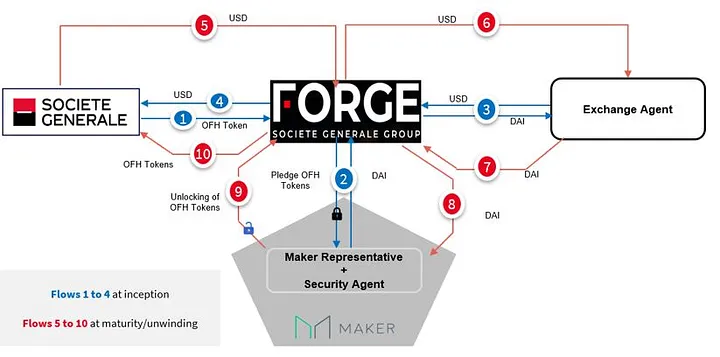
One of the most exciting applications of crypto is DeFi or decentralized finance. DeFi provides several financial instruments such as liquid staking, options, lending, stablecoins, etc. Lending platforms in DeFi allow you to receive a loan by locking up a certain amount of collateral.
MakerDAO, a pioneer and a leader amongst DeFi apps, allows you to lock up collateral to borrow DAI — a stablecoin. Societe Generale, a major French bank, has also secured a loan from MakerDAO. The bank’s digital asset branch, SG-Forge, was given access to a $30 million credit line in DAI, following a unanimous governance vote in August 2022. This move was made possible by pledging €40 million worth of bonds, specifically ‘OFH tokens’ issued on Ethereum and primarily backed by housing loans, as collateral.
This initiative is significant because it represents one of the first times a major traditional bank has engaged with a DeFi protocol for refinancing purposes. Societe Generale used this innovative approach to withdraw $7 million in DAI, a move that showcased the bank’s forward-thinking strategy and also aligned with MakerDAO’s goals to diversify its collateral away from volatile cryptocurrencies and more traditional stablecoins like USDC. The meticulous process took time, reflecting the complexities involved when a large financial institution utilizes emerging DeFi systems.
#3 Fundraising

Startups are increasingly adopting cryptocurrencies as a means to fund their ventures through methods such as Initial Coin Offering (ICO), Initial Exchange Offering (IEO), and Initial DEX Offering (IDO). These crypto fundraising methods allow a startup to issue its own cryptocurrency in exchange for established cryptocurrencies or fiat money. These modern fundraising tools offer a swifter and less costly path to capital acquisition, which can be vital for startups looking to quickly advance their projects.
The global reach of these fundraising methods provides startups with access to a wide pool of potential investors, broadening their fundraising scope beyond geographical limitations. The tokens issued through these fundraising methods, unlike conventional equity in startups, are also tradeable on various cryptocurrency exchanges. This liquidity is attractive to investors who seek flexibility and the ability to sell their stakes easily. However, do keep in mind that some of these issued tokens may have built-in lock-in periods.
#4 Crypto Payrolls and Freelance Payouts
The pandemic has prompted companies to rethink their hiring strategies and adopt remote work. With geographical boundaries no longer a barrier, companies can hire talent from around the world. With its near-instantaneous transaction capability and minimal fees, cryptocurrency stands out as a compelling payroll option for businesses that employ a global workforce.
As such, offering salaries in cryptocurrency is not only becoming a logistical preference but also a strategic perk to attract top talent, especially from regions with restrictive or unstable financial systems. Besides full-time employees, freelancers and contractors around the world are increasingly receptive to being paid in digital currencies.
For companies, the benefits of paying in crypto are multifaceted: transactions are swift, secure, and significantly cheaper than traditional banking methods, plus there’s no risk of chargebacks. For freelancers, getting paid in crypto means easier access to funds with the added potential of cryptocurrency as an investment.
#5 Crypto Payments

Crypto payments are one of the most obvious ways businesses are adopting crypto. By accepting crypto payments, businesses are not just cutting down on hefty transaction fees associated with international banking but are also broadening their customer base. This is particularly beneficial for companies in regions where local currencies are volatile or traditional banking infrastructure is lacking.
The adoption of cryptocurrency for transactions is becoming an innovative solution for businesses looking to access the global market. Services from companies such as
are making it easier for businesses to embrace cryptocurrencies. They act as intermediaries, simplifying the process of accepting and converting cryptocurrencies into local fiat currency, thus addressing the volatility concern.
As cryptocurrencies are becoming more mainstream, businesses that adopt them not only cater to a growing demographic of crypto-users but also project a modern and innovative image. This modernity can be a distinguishing feature, especially for established companies looking to refresh their brand and appeal to a more tech-savvy customer base. Moreover, the possibility of offering discounts for payments made in crypto serves as an additional incentive for customers, potentially increasing sales and enhancing customer loyalty.
Conclusion
Over the past fifteen years, cryptocurrencies have transcended their early underground roots to become a multifaceted asset class woven into the fabric of global business operations. From serving as a hedge against inflation and an alternative investment strategy for corporate portfolios to providing novel avenues for fundraising and streamlining international transactions, cryptocurrencies have demonstrated their versatile utility. Companies like MicroStrategy have capitalized on their investment potential, while others like Societe Generale have explored their applicability in decentralized finance.
The adoption of crypto payrolls and payments is redefining how companies engage with a global workforce and customer base, underscoring a trend towards digital agility and financial innovation. As we mark a decade and a half since Bitcoin’s inception, it is clear that cryptocurrencies have not only secured a place in the present-day business landscape but are also shaping the future of various domains such as commerce, investment, and employment worldwide
Products
Use Cases
© 2026 EukaPay. All rights reserved.
FINTRAC: M22233887